About the Author
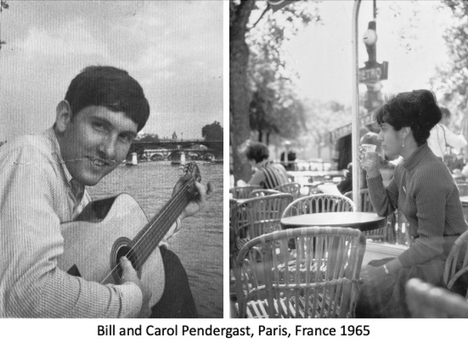
I am a retired American university professor and administrator living in California. I lived in Paris and Brussels and elsewhere in Europe for many years and travel to France as often as possible. My wife Carol is an art historian and we have explored the French countryside with its medieval churches and other art. We met while students in Paris in 1964-65 and you can read about that in "What Happened in Paris." I am not a teacher of French, but I do speak, read and write the language. I am not a musician or music scholar either but I enjoy listening to good music. I am not selling anything and have no commercial objectives from this website. The website is a hobby and public service for the appreciation of French "chanson" and it keeps me very busy. My interests besides language and music are food and wine, travel, art and photography. Enjoy!!
Bill Pendergast
I am a retired American university professor and administrator living in California. I lived in Paris and Brussels and elsewhere in Europe for many years and travel to France as often as possible. My wife Carol is an art historian and we have explored the French countryside with its medieval churches and other art. We met while students in Paris in 1964-65 and you can read about that in "What Happened in Paris." I am not a teacher of French, but I do speak, read and write the language. I am not a musician or music scholar either but I enjoy listening to good music. I am not selling anything and have no commercial objectives from this website. The website is a hobby and public service for the appreciation of French "chanson" and it keeps me very busy. My interests besides language and music are food and wine, travel, art and photography. Enjoy!!
Bill Pendergast
Introduction
This songbook provides an auxiliary approach to the study and enjoyment of French language and culture. Alternatively, it is simply a nice playlist of classic French “chansons.” Many students of foreign languages find that music becomes an integral part of their experience because it is a pleasant vehicle for the absorption of language. I append many notes about language to the translations included here.
Music, Songs and "Chanson"
Music is a patterned use of sounds and silence created by voice and/or instruments. Songs consist of lyrics (words) set to music and performed by singers and instrumentalists to tell stories and elicit emotions that create “meaning” for the listener. Songs vary in the nature and relative importance of the lyrics and the music and in the way(s) they are constructed and conducted. Some songs like “rock & roll” are music-driven with energetic melodies and heavy instrumentation. The “chanson” is a genre of song that originated with specific characteristics but fluid boundaries such that the word has come to be used interchangeably with “song.”
The classic “chanson” is specifically a lyric-driven song, where music intonates and amplifies words, with successive stylistic iterations that date back to medieval times (12th century). Historic “chansons” were often poems set to monophonic (single line) melody with words evocative in meaning and sound, and with structural characteristics of poems such as stanzas, rhyme, meter, rhythm. The poems in early “chanson” told stories (often of courtly love or heroes and noble deeds) that were frequently penned, sung and played with simple instrumentation by the “chansonnier” (“troubadour” or “trouvère”). Thus arose the tradition of the “auteur-compositeur-interprète” (ACI) or “singer/songwriter.” Like other cultural expressions, "chanson" bears traces of its environment. In the immediate post-WWII years, the narrowness of "cabaret" and bar venues restricted musical accompaniment to, at most, a guitar. For many years, it was also mostly a man's world in the lyrical domain. Over time, the contours of “chanson” have evolved with changes in the audience, performers, instruments, and practices in music and language.
Practically, the challenge for a website like this one is to preserve a meaningful contemporary concept of “chanson” as a musical genre that retains essential components in an evolved musical environment. For the purposes of this website, the criteria of inclusion extend to songs that “more or less” (to be flexible) share certain characteristics. Some performances may stray beyond these boundaries, but that does not invalidate their inclusion as “chansons.” The first criterion is that they are vocal and not merely instrumental. Second, the vocal performance is primarily individual rather than group (band or chorus). Duets fall within permissible bounds. Third, the lyrics are important for their content and not just sound. "Chansons" tell stories and articulate aspects of the human condition which, of course, varies with time and place. Fourth, to the extent that the songs are accompanied, the instrumentality (musical as well as visual) is secondary to the lyrics. Non-intrusive amplification of sound, instrumentation, or visual components does not disqualify. Fifth, "chansons" activate a primary response by listeners that is “internal” (emotions or intellect) rather than physical as with dance music.
Music is a patterned use of sounds and silence created by voice and/or instruments. Songs consist of lyrics (words) set to music and performed by singers and instrumentalists to tell stories and elicit emotions that create “meaning” for the listener. Songs vary in the nature and relative importance of the lyrics and the music and in the way(s) they are constructed and conducted. Some songs like “rock & roll” are music-driven with energetic melodies and heavy instrumentation. The “chanson” is a genre of song that originated with specific characteristics but fluid boundaries such that the word has come to be used interchangeably with “song.”
The classic “chanson” is specifically a lyric-driven song, where music intonates and amplifies words, with successive stylistic iterations that date back to medieval times (12th century). Historic “chansons” were often poems set to monophonic (single line) melody with words evocative in meaning and sound, and with structural characteristics of poems such as stanzas, rhyme, meter, rhythm. The poems in early “chanson” told stories (often of courtly love or heroes and noble deeds) that were frequently penned, sung and played with simple instrumentation by the “chansonnier” (“troubadour” or “trouvère”). Thus arose the tradition of the “auteur-compositeur-interprète” (ACI) or “singer/songwriter.” Like other cultural expressions, "chanson" bears traces of its environment. In the immediate post-WWII years, the narrowness of "cabaret" and bar venues restricted musical accompaniment to, at most, a guitar. For many years, it was also mostly a man's world in the lyrical domain. Over time, the contours of “chanson” have evolved with changes in the audience, performers, instruments, and practices in music and language.
Practically, the challenge for a website like this one is to preserve a meaningful contemporary concept of “chanson” as a musical genre that retains essential components in an evolved musical environment. For the purposes of this website, the criteria of inclusion extend to songs that “more or less” (to be flexible) share certain characteristics. Some performances may stray beyond these boundaries, but that does not invalidate their inclusion as “chansons.” The first criterion is that they are vocal and not merely instrumental. Second, the vocal performance is primarily individual rather than group (band or chorus). Duets fall within permissible bounds. Third, the lyrics are important for their content and not just sound. "Chansons" tell stories and articulate aspects of the human condition which, of course, varies with time and place. Fourth, to the extent that the songs are accompanied, the instrumentality (musical as well as visual) is secondary to the lyrics. Non-intrusive amplification of sound, instrumentation, or visual components does not disqualify. Fifth, "chansons" activate a primary response by listeners that is “internal” (emotions or intellect) rather than physical as with dance music.
Song Architecture
Songs tell stories that convey meaning by arranging words and music into sequential packages of building blocks. The specific sequence of those packages represents the song’s structure or formula and affects our response. Song formulas designate the sequence of these main parts: verses, chorus, and bridge (e.g. VCVC, or VCVCBC, etc).
Stanzas are groups of lines containing words. The lines may be long or short and there may be many or few lines in a stanza. All lines have a last word and if those words sound similar then they rhyme either randomly or in a pattern (ABAB or AABB, etc).
Stanzas come in different types (verse, chorus, bridge, etc.). Each type of stanza has a purpose in the story and together they give the song its structure. Like stories, songs unfold over time from beginning to middle and end. In a song, Verses provide the main story information; each has the same melody and chords but different lyrics; verses often begin or end with a “refrain” that recurs in the song. The chorus contains the emotional heart of the song and is often anthemic and louder than a verse. A chorus usually has the same melody and lyric each time it appears and often includes a “hook” (like the song’s title) in its first or last line. The bridge (“pont” or Middle 8) is a short change-up section with a unique melody, instrumentation or lyric and often represents the peak (and sometimes surprising) moment in the song; not every song has a bridge.
Some songs include segments similar to a culinary “amuse-bouche” or short diversion sprinkled among the stanzas. These include an introduction, pre-chorus, break/solo, outro/coda, or interlude with a distinctive melody or instrument. An intro sets the stage, tone or mood with its key, rhythm or energy. A break/solo is often an instrumental transition. An outro/coda is the ending, sometimes the “hook” or part of the chorus. A tag repeats the ending line.
Songs tell stories that convey meaning by arranging words and music into sequential packages of building blocks. The specific sequence of those packages represents the song’s structure or formula and affects our response. Song formulas designate the sequence of these main parts: verses, chorus, and bridge (e.g. VCVC, or VCVCBC, etc).
Stanzas are groups of lines containing words. The lines may be long or short and there may be many or few lines in a stanza. All lines have a last word and if those words sound similar then they rhyme either randomly or in a pattern (ABAB or AABB, etc).
Stanzas come in different types (verse, chorus, bridge, etc.). Each type of stanza has a purpose in the story and together they give the song its structure. Like stories, songs unfold over time from beginning to middle and end. In a song, Verses provide the main story information; each has the same melody and chords but different lyrics; verses often begin or end with a “refrain” that recurs in the song. The chorus contains the emotional heart of the song and is often anthemic and louder than a verse. A chorus usually has the same melody and lyric each time it appears and often includes a “hook” (like the song’s title) in its first or last line. The bridge (“pont” or Middle 8) is a short change-up section with a unique melody, instrumentation or lyric and often represents the peak (and sometimes surprising) moment in the song; not every song has a bridge.
Some songs include segments similar to a culinary “amuse-bouche” or short diversion sprinkled among the stanzas. These include an introduction, pre-chorus, break/solo, outro/coda, or interlude with a distinctive melody or instrument. An intro sets the stage, tone or mood with its key, rhythm or energy. A break/solo is often an instrumental transition. An outro/coda is the ending, sometimes the “hook” or part of the chorus. A tag repeats the ending line.
The Life of Songs
Songs differ from other artistic creations. Songs have lives of their own. Songs are often collaborations by different artists who contribute different parts: music, lyrics, and performance. Songs are not fixed physical objects, unlike paintings, sculpture, and architecture. Songs are portable and malleable over time and space. They are organic, living things, so the life of songs can be unpredictable and fascinating as they move from culture to culture.
Many songs include music and words that are both composed by a single person and performed by that same person. In French, this is referred to as ACI: "auteur-compositeur-interprète" (singer-songwriter). In other cases, the music and lyrics may be composed by different people and performed by different instruments or combination of instruments, or by different vocalists, all of which can provoke various interpretations or meanings.
Many singer-songwriters never hit their stride until they work with a compatible music arranger. Arrangement is one of the most crucial but perhaps least understood of music roles. The various roles themselves often have permeable boundaries. Many arrangers are also composers. Arrangement involves structuring the distinctive parts of a song into a coherent and engaging piece of music. It can also involve decisions regarding the selection of instruments, their order of appearance and mixing. Alain Goraguer was one such indispensable partner for the likes of Boris Vian, Serge Gainsbourg, and many others and he reappears throughout the years covered by this website. Gabriel Yared played a similar role for Françoise Hardy. "Covers" of songs can have a similar effect. Songs may languish or decline for some time before they are resuscitated as a "cover" by performers with different attributes and skills. "Covers" may occur with either original or adapted songs.
Purely instrumental music can have many interpretations but when it achieves certain heights it is perhaps best left wordless to speak its own truth. As Morgan Freeman’s character in The Shawshank Rebellion commented after hearing Mozart’s Duettino “Sull’Aria” in the prison yard scene: “I have no idea to this day what those two Italian ladies were singing about. Truth is, I don’t want to know. Some things are best left unsaid. I’d like to think they were singing about something so beautiful, it can’t be expressed in words, and makes your heart ache because of it.”
Occasionally, songs arise from music that is composed initially without words and lyrics are added afterwards (e.g. Django Reinhardt’s “Nuages”). When lyrics are added in several languages, as with “Nuages,” it can be interesting to compare the interpretations that emerge from the combination of different lyrics with the same music. For example, Reinhardt released “Nuages” in 1940. Two years later, Jacques Larue wrote French lyrics followed in 1946 by Spencer Williams with English lyrics and quite a different title (“It’s the Bluest Kind of Blues”).
In other cases, entirely new lyrics may be written for music that was originally paired with lyrics in another language. This process is generally termed "adaptation," and it differs from "translation." For example, Frank Sinatra’s famous rendition of “My Way” became an anthem of scrappy individualism and triumph over adversity. Canadian Paul Anka wrote those English lyrics and combined them with music performed earlier by French singer Claude François for the song “Comme d’Habitude” (“As Usual”). Ironically, the latter song narrated a hang-dog ballad of a man in a failing relationship who repeated the same routine every day. It is a creative challenge to re-work lyrics this way and it can completely change the interpretation of the original song’s “meaning.” Such English language re-formulations are of little help for listeners to learn and understand the original French lyrics. On the other hand, adaptations are framed to appeal to people of different cultures and comparing an original with an adapted song can provide significant insight into those cultural differences.
Songs among “chansons” that have their original version in French and then experience transformation through "adaptation" include: “La Mer” (Charles Trenet), “Sous Le Ciel de Paris” (Edith Piaf), “La Vie en Rose” (Edith Piaf), “Les Feuilles Mortes” (Yves Montand), “Hier Encore” (Charles Aznavour), “Tous Les Visages d’Amour” (Charles Aznavour), “C’Est Si Bon” (Yves Montand), “Comme d’Habitude” (Claude François), “Nuages” (Django Reinhardt), and “La Belle Vie” (Sacha Distel). Other French songs are themselves adaptations of songs that appeared originally in another language, mostly English, but have equally interesting life paths. These include: “Comment Te Dire Adieu” (Françoise Hardy), “Les Champs Elysées” (Joe Dassin). In this international migration, it is invariably music rather than lyrics that does the traveling, since music speaks globally but language has local roots.
Intrinsic to the “life of songs” are the circumstances that generate and sustain them. While French “chanson” has a long history, the focus in this website is primarily the immediate post-WWII period, which is generally regarded as "chanson's" golden period. The revival of “chanson” in France after WWII was not simply a renewed expression of a genetic national trait. It was a specific historic event after the German occupation had curtailed many artistic activities—an event that reflected a convergence of tradition, people, places and context.
In postwar Paris, both jazz and “chanson” flourished with jazz geo-located strongly around Saint Germain des Près and “chanson” in the foothills of Montmartre. Jacques Canetti was a key player in the resurgence of “chanson” in Paris after WWII with his mentoring strategy for artists and his opening of Les Trois Baudets (The Three Donkeys) theater in 1947 near Pigalle at the foot of Montmartre. The embedded French tradition of “chanson” and the free-wheeling “spirit of the times” during Liberation played their own significant roles in the supportive “chanson” ecology that included performance venues, recording opportunities and touring.
Songs differ from other artistic creations. Songs have lives of their own. Songs are often collaborations by different artists who contribute different parts: music, lyrics, and performance. Songs are not fixed physical objects, unlike paintings, sculpture, and architecture. Songs are portable and malleable over time and space. They are organic, living things, so the life of songs can be unpredictable and fascinating as they move from culture to culture.
Many songs include music and words that are both composed by a single person and performed by that same person. In French, this is referred to as ACI: "auteur-compositeur-interprète" (singer-songwriter). In other cases, the music and lyrics may be composed by different people and performed by different instruments or combination of instruments, or by different vocalists, all of which can provoke various interpretations or meanings.
Many singer-songwriters never hit their stride until they work with a compatible music arranger. Arrangement is one of the most crucial but perhaps least understood of music roles. The various roles themselves often have permeable boundaries. Many arrangers are also composers. Arrangement involves structuring the distinctive parts of a song into a coherent and engaging piece of music. It can also involve decisions regarding the selection of instruments, their order of appearance and mixing. Alain Goraguer was one such indispensable partner for the likes of Boris Vian, Serge Gainsbourg, and many others and he reappears throughout the years covered by this website. Gabriel Yared played a similar role for Françoise Hardy. "Covers" of songs can have a similar effect. Songs may languish or decline for some time before they are resuscitated as a "cover" by performers with different attributes and skills. "Covers" may occur with either original or adapted songs.
Purely instrumental music can have many interpretations but when it achieves certain heights it is perhaps best left wordless to speak its own truth. As Morgan Freeman’s character in The Shawshank Rebellion commented after hearing Mozart’s Duettino “Sull’Aria” in the prison yard scene: “I have no idea to this day what those two Italian ladies were singing about. Truth is, I don’t want to know. Some things are best left unsaid. I’d like to think they were singing about something so beautiful, it can’t be expressed in words, and makes your heart ache because of it.”
Occasionally, songs arise from music that is composed initially without words and lyrics are added afterwards (e.g. Django Reinhardt’s “Nuages”). When lyrics are added in several languages, as with “Nuages,” it can be interesting to compare the interpretations that emerge from the combination of different lyrics with the same music. For example, Reinhardt released “Nuages” in 1940. Two years later, Jacques Larue wrote French lyrics followed in 1946 by Spencer Williams with English lyrics and quite a different title (“It’s the Bluest Kind of Blues”).
In other cases, entirely new lyrics may be written for music that was originally paired with lyrics in another language. This process is generally termed "adaptation," and it differs from "translation." For example, Frank Sinatra’s famous rendition of “My Way” became an anthem of scrappy individualism and triumph over adversity. Canadian Paul Anka wrote those English lyrics and combined them with music performed earlier by French singer Claude François for the song “Comme d’Habitude” (“As Usual”). Ironically, the latter song narrated a hang-dog ballad of a man in a failing relationship who repeated the same routine every day. It is a creative challenge to re-work lyrics this way and it can completely change the interpretation of the original song’s “meaning.” Such English language re-formulations are of little help for listeners to learn and understand the original French lyrics. On the other hand, adaptations are framed to appeal to people of different cultures and comparing an original with an adapted song can provide significant insight into those cultural differences.
Songs among “chansons” that have their original version in French and then experience transformation through "adaptation" include: “La Mer” (Charles Trenet), “Sous Le Ciel de Paris” (Edith Piaf), “La Vie en Rose” (Edith Piaf), “Les Feuilles Mortes” (Yves Montand), “Hier Encore” (Charles Aznavour), “Tous Les Visages d’Amour” (Charles Aznavour), “C’Est Si Bon” (Yves Montand), “Comme d’Habitude” (Claude François), “Nuages” (Django Reinhardt), and “La Belle Vie” (Sacha Distel). Other French songs are themselves adaptations of songs that appeared originally in another language, mostly English, but have equally interesting life paths. These include: “Comment Te Dire Adieu” (Françoise Hardy), “Les Champs Elysées” (Joe Dassin). In this international migration, it is invariably music rather than lyrics that does the traveling, since music speaks globally but language has local roots.
Intrinsic to the “life of songs” are the circumstances that generate and sustain them. While French “chanson” has a long history, the focus in this website is primarily the immediate post-WWII period, which is generally regarded as "chanson's" golden period. The revival of “chanson” in France after WWII was not simply a renewed expression of a genetic national trait. It was a specific historic event after the German occupation had curtailed many artistic activities—an event that reflected a convergence of tradition, people, places and context.
In postwar Paris, both jazz and “chanson” flourished with jazz geo-located strongly around Saint Germain des Près and “chanson” in the foothills of Montmartre. Jacques Canetti was a key player in the resurgence of “chanson” in Paris after WWII with his mentoring strategy for artists and his opening of Les Trois Baudets (The Three Donkeys) theater in 1947 near Pigalle at the foot of Montmartre. The embedded French tradition of “chanson” and the free-wheeling “spirit of the times” during Liberation played their own significant roles in the supportive “chanson” ecology that included performance venues, recording opportunities and touring.
Translation and Adaptation
Song translation is a challenging subset of the more general translation enterprise. It is important to differentiate song translations according to their purpose. This website offers translations only to foster understanding of the original French lyrics and to assist readers to learn French. Such a purpose has its own challenges. Like poetry, for example, the original language of songs is often intentionally ambiguous in ways that make the capture of meaning elusive even for native speakers.
Additionally, the element of national culture draws a semi-transparent veil between a song and the translator. As pointed out elsewhere on this website, Edward Hall outlined a conception of France as a “high context” national culture in his 1959 book “The Silent Language.” In “high context” cultures, meaning in communication depends heavily on contextual clues like shared history, non-verbal clues and implicit understanding of social relationships. Persons from “low context” cultures, like the United States, depend primarily on the explicit meaning of words. This typology of “context” as a dimension of culture has become a bedrock feature of cultural anthropology. It helps understand why accurate communication between people of different cultures is so perilous and constitutes a bar to effective translation.
Some other translations are intended to create new songs that are actually singable in another language. This presents a higher bar than translation for understanding an original text. The singable translation must fit an existing melody like a glove. Playable song translations require words that fit a pre-established melody and encounter many linguistic obstacles in doing so. Language syntax and word phonetics are just some challenges. This may be one reason why many songs are treated to “adaptation” instead of “translation.”
Song "adaptation" arises in musical theater as a way to accommodate the diverse and unique needs of the lyrics, the music, the performers and the audience. Addressing each of these elements, Herbert Kretzmer makes striking observations: "the lyric writer's first obligation is to be singable...poets have greater freedom since they work alone and don't have a rigid shape imposed on them by collaborators...A lyric writer follows the music or he's dead...certain sounds cannot, or should not, be sung...A line with too many “ss”s in it, for instance, should at all costs be avoided, because it’s bound to emerge on stage as an incomprehensible series of sibilants...it is unfair and impractical to ask a singer to sing a word like “me” on a high, sustained note, because…the “eee” vowel tends to close the singer’s throat…There are certain words...like “marriage” or “courage” or “tickle” where the second syllable cannot be held or extended...your text must be instantly understood. A reader can mull over a line of poetry…music, in a song, is relentless. You can’t ask an audience to pause and reflect on a line of lyrics.”
A purpose of this songbook is to assist learners to grasp language, words and meaning. Song translation is both art and science. In general, translations are either literal or poetic. Translations that are too literal (word-for-word) can impede comprehension since similar words may have different meaning. More interpretive (poetic) translations, on the other hand, can stray so far from the original words that they contribute little to language learning. In my translations and notes of the lyrics, I try to thread a middle path between strict translation of words and creative interpretation that is untethered from the original language. It is often difficult to fathom, much less express, the intended meaning of lyrics written by songwriters of strong poetic disposition like Leo Ferré and Jacques Brel, or those like Serge Gainsbourg who deliberately employ ambiguity and wordplay. My notes beneath translations (“NB= nota bene”) explain difficult words or phrases highlighted in the text by bold italics.
Song translation is a challenging subset of the more general translation enterprise. It is important to differentiate song translations according to their purpose. This website offers translations only to foster understanding of the original French lyrics and to assist readers to learn French. Such a purpose has its own challenges. Like poetry, for example, the original language of songs is often intentionally ambiguous in ways that make the capture of meaning elusive even for native speakers.
Additionally, the element of national culture draws a semi-transparent veil between a song and the translator. As pointed out elsewhere on this website, Edward Hall outlined a conception of France as a “high context” national culture in his 1959 book “The Silent Language.” In “high context” cultures, meaning in communication depends heavily on contextual clues like shared history, non-verbal clues and implicit understanding of social relationships. Persons from “low context” cultures, like the United States, depend primarily on the explicit meaning of words. This typology of “context” as a dimension of culture has become a bedrock feature of cultural anthropology. It helps understand why accurate communication between people of different cultures is so perilous and constitutes a bar to effective translation.
Some other translations are intended to create new songs that are actually singable in another language. This presents a higher bar than translation for understanding an original text. The singable translation must fit an existing melody like a glove. Playable song translations require words that fit a pre-established melody and encounter many linguistic obstacles in doing so. Language syntax and word phonetics are just some challenges. This may be one reason why many songs are treated to “adaptation” instead of “translation.”
Song "adaptation" arises in musical theater as a way to accommodate the diverse and unique needs of the lyrics, the music, the performers and the audience. Addressing each of these elements, Herbert Kretzmer makes striking observations: "the lyric writer's first obligation is to be singable...poets have greater freedom since they work alone and don't have a rigid shape imposed on them by collaborators...A lyric writer follows the music or he's dead...certain sounds cannot, or should not, be sung...A line with too many “ss”s in it, for instance, should at all costs be avoided, because it’s bound to emerge on stage as an incomprehensible series of sibilants...it is unfair and impractical to ask a singer to sing a word like “me” on a high, sustained note, because…the “eee” vowel tends to close the singer’s throat…There are certain words...like “marriage” or “courage” or “tickle” where the second syllable cannot be held or extended...your text must be instantly understood. A reader can mull over a line of poetry…music, in a song, is relentless. You can’t ask an audience to pause and reflect on a line of lyrics.”
A purpose of this songbook is to assist learners to grasp language, words and meaning. Song translation is both art and science. In general, translations are either literal or poetic. Translations that are too literal (word-for-word) can impede comprehension since similar words may have different meaning. More interpretive (poetic) translations, on the other hand, can stray so far from the original words that they contribute little to language learning. In my translations and notes of the lyrics, I try to thread a middle path between strict translation of words and creative interpretation that is untethered from the original language. It is often difficult to fathom, much less express, the intended meaning of lyrics written by songwriters of strong poetic disposition like Leo Ferré and Jacques Brel, or those like Serge Gainsbourg who deliberately employ ambiguity and wordplay. My notes beneath translations (“NB= nota bene”) explain difficult words or phrases highlighted in the text by bold italics.
The Artists
Songs have been selected because they are in French. The artists may or may not be French. One of the interesting notes is the large number of artists who are either immigrants or children of immigrants driven to France by war, revolution, economics or discrimination. Whatever the ethnic origin, something of the itinerant in them leads to song.
The stories narrated on this website describe the many successive stages of artistic development that performers navigate to achieve success. Artists need to clarify goals, develop musical performance and songwriting skills, formulate a brand identity and construct playlists within a defined musical space, gain a deft understanding of the A&R function at record companies, cultivate public exposure, collaborators and producers, develop a following, and cement a legacy. These outcomes hinge on related behaviors. The trajectory varies individually, but generally it leads from early appearances on street corners, bars and gigs, to music halls and a strategic release of recordings on singles, EPs and LPs, carefully crafted studio albums and extemporaneous live albums, social media, music festivals and concert tours, promotion and marketing. The process often concludes with album compilations, duets, residencies and other packages of established materials. Only a few aspirants finally grasp the ring.
Compliments for the image below: The Paris Review
The Artists
Songs have been selected because they are in French. The artists may or may not be French. One of the interesting notes is the large number of artists who are either immigrants or children of immigrants driven to France by war, revolution, economics or discrimination. Whatever the ethnic origin, something of the itinerant in them leads to song.
The stories narrated on this website describe the many successive stages of artistic development that performers navigate to achieve success. Artists need to clarify goals, develop musical performance and songwriting skills, formulate a brand identity and construct playlists within a defined musical space, gain a deft understanding of the A&R function at record companies, cultivate public exposure, collaborators and producers, develop a following, and cement a legacy. These outcomes hinge on related behaviors. The trajectory varies individually, but generally it leads from early appearances on street corners, bars and gigs, to music halls and a strategic release of recordings on singles, EPs and LPs, carefully crafted studio albums and extemporaneous live albums, social media, music festivals and concert tours, promotion and marketing. The process often concludes with album compilations, duets, residencies and other packages of established materials. Only a few aspirants finally grasp the ring.
Compliments for the image below: The Paris Review